Theses and Dissertations

Making Memory Work (PhD thesis)

The Impact of Museums and Memorials on Reconciliation in Rural Communities of Latin America. A Comparative Research Project in Peru and Guatemala

This PhD project examines the growing phenomenon of creating ‘places of memory’ – e.g. museums and memorials – as part of the process of truth-seeking in post-conflict settings, taking the examples of Guatemala and Peru. In particular, the project will focus on places of memory in rural areas, which are playing a role in processes of reconciliation within communities. As well as addressing the multiple meanings of the concept of ‘reconciliation’, this dissertation will investigate the perceptions and meanings that different social actors involved in these processes attach to the places concerned. The research will also reflect on the potentially conflicting fields of global and local memory cultures.

Project duration: since 2009
Contact: .(JavaScript must be enabled to view this email address), Georg Zundel PhD grant student
Supervision: Prof. Hans J. Giessmann/Prof. Sven Chojnacki, Freie Universität Berlin/Dr. Martina Fischer

Top
 

Kashmir and Regional Security (PhD thesis)

Paradigms of Peace and Prospects for Conflict Transformation

The purpose of this study is to understand the root-causes of the Kashmir conflict and explore peaceful alternatives for transforming it in order to bring peace and prosperity to the region. After the reciprocal atomic tests by both India and Pakistan, the Kashmir conflict became a nuclear flashpoint and a striking threat to the peace and security in the South Asian region. This study seeks to establish an alternative architecture for security and conflict transformation. It explores and analyzes the competing interests of stakeholders involved with this issue to find a win-win solution. It also offers an analysis of the complexities of the internal, intra-state and intractable conflicts. In addition, this research aims to identify and evaluate the existing theoretical frameworks for conflict transformation and seeks for a paradigm shift away from the traditional contours of the Kashmir problem. How to build peace and sustain it in divided societies, which are based on ethnic identities, will be the major focus of this dissertation.

Project duration: since 2009
Contact: .(JavaScript must be enabled to view this email address), Georg Zundel PhD grant student
Supervision: Prof. Hans J. Giessmann/Prof. Sven Chojnacki, Freie Universität Berlin

Top
 

Interactive Theatre in Post-War Lebanon (PhD thesis)

15 years after the official end of the civil war, Lebanese society continues to be highly fragmented. Ethnopolitical allegiance not only shapes state structures and the legal framework, but permeates all institutions of society right down to the identity formation of individuals. The war led to geographic fragmentation, where flight and expulsion created more or less homogeneous villages and town districts. It also created a “geography of fear” (Khalaf) which makes relationship-building between groups in society even more difficult. However, sustainable peace can only be created through relationship-building that will ultimately lead to a transformation of social institutions and structures. Based on action research, this project investigates methods employed by local peace activists to create a space for such relationship-building. Its goals are twofold: to develop concrete insights into meaningful action available to local activists who presently engage in Lebanon; and to formulate general insights with respect to methods of relationship-building that can claim universal relevance.

The method of relationship-building that forms the focal point of the project is “Forum Theatre”, where, through a series of workshops, participants from formerly antagonistic groups work together to create common “places of change”. Participants address real-life situations that they all experience as unsatisfactory and frustrating, and thus have a wish to change.

Project duration: since 2004
Contact: .(JavaScript must be enabled to view this email address)
Supervision: Prof. Jürgen Pohl, University of Bonn

Top
 

State Collapse – the Cause of Violent Conflicts? (PhD thesis)

A Systemic/Constructivist Analysis of the Political Order in Sudan

Taking the current conflict situation in Sudan, this PhD project aims to develop a methodology for analysing violent conflicts which combines elements of systemic and constructivist theory to create a dynamic framework. This framework is not so much about filtering out individual conflict causes to develop a goal-orientated strategy, but more about focusing on the processual and circular nature of social change and distinguishing destructive feedback loops from the more constructive ones. Although the planned dissertation has a strong practical relevance, it is essential to draw on academic theory to construct a methodological framework for analysing violent political conflicts.

Project duration: since 2007
Contact: .(JavaScript must be enabled to view this email address)
Supervision: Prof. Thorsten Bonacker, Philipps-Universität Marburg/Prof. Hans J. Giessmann, Dr. Norbert Ropers

Top
 

Institutionalised Dialogue and Negotiation Support Structures (PhD thesis)

The Contribution of Peace Secretariats to Conflict Transformation in Sri Lanka

Facilitating contact, exchange and cooperation among parties in an ethnopolitical conflict can take a great variety of organisational and technical forms. This PhD project seeks to understand the contribution made by the ‘peace secretariats’ in Sri Lanka during the peace process of 2002. These are institutionalised dialogue and negotiation support structures set up to perform secretarial functions during negotiations, to help implement peace accords and to support monitoring and communication efforts made by conflict parties. The main interest behind this research is to understand whether institutionalising such support structures is beneficial to the peace process, and to conflict transformation in general. Based on a review of relevant concepts such as regime theory, institutional theory and impact assessment, it will contribute towards establishing a theoretical foundation for institutionalised dialogue and negotiation support structures. By examining the experiences in Sri Lanka and comparing them with other similar conflict cases (e.g. South Africa, Nepal or Colombia), it should become possible to develop conclusions on the transferability of the findings and to make further research recommendations.

Project duration: since 2009
Contact: .(JavaScript must be enabled to view this email address)
Supervision: Prof. Hans J. Giessmann/Dr. Norbert Ropers

Top
 

“Victimhood in Dialogue” - Peacebuilding and Dealing with the Past in Post-War Regions (PhD thesis)

The main objective of this PhD project, begun in 2009, is to investigate the interrelations between politically-motivated violence and identity formation, both individual and collective. The aim is to explore forms of external support for regenerating post-war societies that are conducive to preventing violent conflicts from recurring, particularly in areas where the perceived identity of victimhood is fuelling the political discourse. The research will focus on dialogue projects that are currently underway, initiated and supported by external actors in such regions. The organisers and participants will be interviewed about their experiences and interactions, in order to reflect on appropriate ways to deal with the experience of victimhood in conflicts and peace processes.

Project duration: since 2009
Contact: .(JavaScript must be enabled to view this email address)
Supervision: Prof. Hans J. Giessmann/Dr. Martina Fischer

Top
 

Human Rights Networks in Conflicts of Secession and De Facto Regimes (PhD thesis)

Northern Cyprus, Abkhazia and Transnistria are regions which have functioning de facto state-like structures that are capable of sovereignty, but are not recognised as sovereign by the majority of the international community. In addition, they are bound up in conflict dynamics between a ‘host state’ striving for territorial integrity and the protective power of a third country. One question which arises in this kind of situation is how internationally recognised human rights can be protected, established and ultimately guaranteed.

The absence of international mechanisms for protecting human rights and the lack of any international obligations within the de facto regimes means that the ruling party cannot formally be held to account for grievances or violations against its citizens. At the same time, conflict dynamics can sometimes lead to the host state accepting human rights abuses, in order to avoid taking steps that could lead to the secession of the de facto regime being recognised, even if these steps are only implicit.

Within this complex dynamic, however, it is possible to identify networks of actors who are working energetically to promote individual human rights. This dissertation seeks to understand the relationships, strategies and organisations within these networks, and also to identify the domestic and international factors which help or hinder their work. It also seeks to determine the influence which these networks of actors exert on the conflict dynamics themselves, and to assess the interrelation between human rights work and the course of a conflict. The research focus is on case studies of Georgia and Moldova.

Project duration: since 2009
Contact: .(JavaScript must be enabled to view this email address)
Supervision: Prof. Hans J. Giessmann/Dr. Oliver Wolleh

Top
 

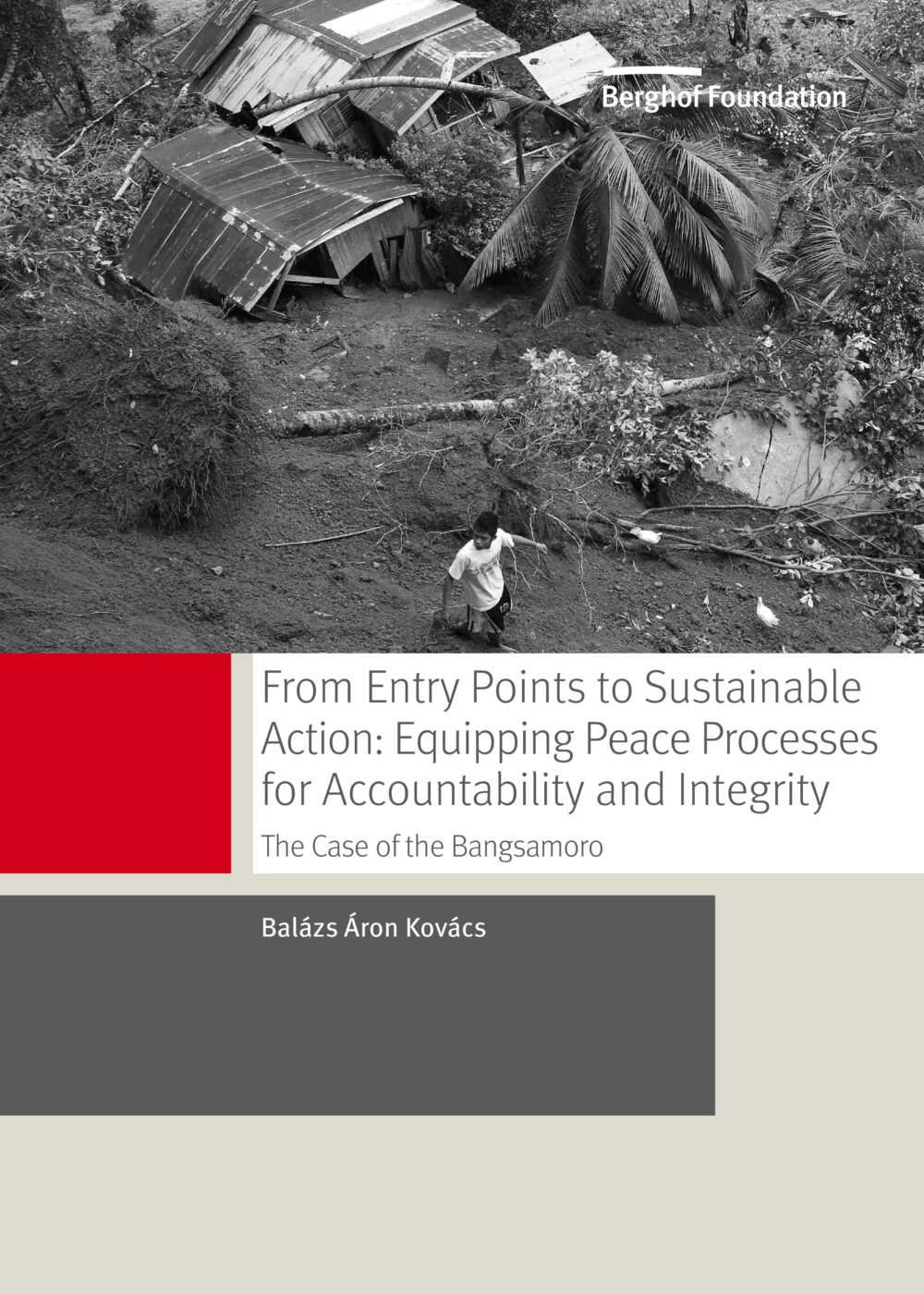
The Bangsamoro Rebellion (PhD thesis)

Mediation Efforts and the Role of Armed Groups in Conflict Transformation Towards Re-Establishing the State’s Monopoly on the Use of Force

This dissertation project at the University of Hamburg deals with mediation efforts and the role of armed groups in conflict transformation towards re-establishing the state’s monopoly on the use of force. The case study focuses on the violent conflict in the Southern Philippines (Mindanao) between the Philippine government and the Muslim Filipinos. The project combines elements of conflict analysis, conflict transformation theory debate and practical conflict resolution and mediation approaches in intra-state conflicts.

Project duration: 2009-2012
Contact: Thomas Boehlke
Supervision: Prof. Hans J. Giessmann

Top